


















Direkt zum Inhalt

Warenkorb

  • gerade nicht auf Lager
    Stuart Elden, Elizabeth Lebas, Eleonore…

    Henri Lefebvre. Key Writings

  • Laurence A. Rickels

    Ulrike Ottinger. Eine Autobiografie

  • N. John Habraken, Arnulf Lüchinger

    Die Träger und die Menschen. Das Ende des Massenwohnungsbau…

  • gerade nicht auf Lager
    Liz Kotz

    Words to Be Looked at. Language in 1960s Art

  • gerade nicht auf Lager
    Guy Debord

    Comments on the Society of the Spectacle

  • Michel de Certeau

    Kunst des Handelns

  • gerade nicht auf Lager
    Jacques Ranciere

    Ist Kunst widerständig?

  • Alain Badiou

    Wofür steht der Name Sarkozy?

  • gerade nicht auf Lager
    Donna Haraway

    Die Neuerfindung der Natur. Primaten, Cyborgs und Frauen.

  • gerade nicht auf Lager
    Stefanie Schulte Strathaus, Florian…

    Wer sagt denn, dass Beton nicht brennt, hast Du’s probiert?

  • gerade nicht auf Lager
    Henri Lefebvre

    Writings on Cities

  • Loretta Napoleoni

    Rogue Economics. Capitalism's New Reality

  • AD

    AD 174. Vol. 75. Nr. 2. Samantha Hardingham. The 1970'…

  • An Architektur

    An Architektur 18: Camp for Oppositional Architecture:…

  • Johan Frederik Hartle

    Der geöffnete Raum. Zur Politik der ästhetischen Form

  • An Architektur

    An Architektur 16-17

  • Vera Beyer, Jutta Voorhoeve, Anselm…

    Das Bild ist der König. Repräsentation nach Louis Marin

  • An Architektur

    An Architektur 15 / FFM 11: Europäische…

  • An Architektur

    An Architektur 14: Camp for Oppositional Architecture

  • An Architektur

    An Architektur 11-13: Theorie und Praxis der Kartografie

  • An Architektur

    An Architektur 10: Gemeinschaftsräume

  • An Architektur

    An Architektur 04-09: Krieg und die Produktion von Raum

  • IDEA Magazine

    IDEA 296. Books <preposition> graphic design

  • IDEA Magazine

    IDEA 293. Stanley Donwood / Vacances. DD-DDD / Dimensions…

  • gerade nicht auf Lager
    An Architektur

    An Architektur 01-03

  • Pro qm

    Gutschein / Voucher

  • Siegfried Kracauer

    Das Ornament der Masse. Essays

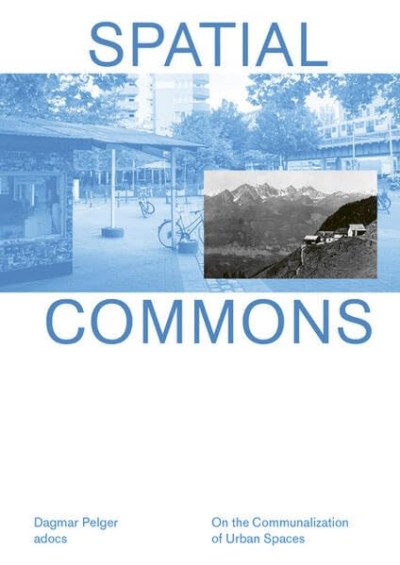
Spatial Commons. On the Communalization of Urban Spaces

What do open spaces in the city have to do with commercial spaces and housing? If the city is a common good, then recreational, commercial, and residential spaces can all potentially be understood as commons. Through acts of inclusive and collective appropriation, all of these spaces can form spatial types of commoning, functioning beyond the categories of public and private. These spatial resources of the city, as well as the rules, conventions, and social relationships that organize coexistence in these spaces, are based on an idea of ownership that is oriented towards common use, rather than profit.

Dagmar Pelger explores the multi-layered and contradictory potential of the concept of the commons. Through cartographic surveys of specific locations in Berlin, the spatial phenomena and characteristics of communalization become visible. The interdisciplinary process of mapping provides information about the types, processes, and rules of commoning as a spatial practice. In doing so, it points towards different ways of shaping the city as a spatial commons.

This book clarifies conceptual terminology and presents practical methods for describing urban space. It is aimed at urban researchers, architects and planners, as well as cultural workers and all those who are interested in, or would like to work on, use-oriented processes of commoning and mapping as a tool for spatial exploration.


Dagmar Pelger
Spatial Commons. On the Communalization of Urban Spaces
Adocs, 2025, 978-3-943253-90-0
28,00 €