















Direkt zum Inhalt

Warenkorb

  • N. John Habraken, Arnulf Lüchinger

    Die Träger und die Menschen. Das Ende des Massenwohnungsbau…

  • gerade nicht auf Lager
    Liz Kotz

    Words to Be Looked at. Language in 1960s Art

  • gerade nicht auf Lager
    Guy Debord

    Comments on the Society of the Spectacle

  • Michel de Certeau

    Kunst des Handelns

  • gerade nicht auf Lager
    Jacques Ranciere

    Ist Kunst widerständig?

  • Alain Badiou

    Wofür steht der Name Sarkozy?

  • gerade nicht auf Lager
    Donna Haraway

    Die Neuerfindung der Natur. Primaten, Cyborgs und Frauen.

  • gerade nicht auf Lager
    Stefanie Schulte Strathaus, Florian…

    Wer sagt denn, dass Beton nicht brennt, hast Du’s probiert?

  • gerade nicht auf Lager
    Henri Lefebvre

    Writings on Cities

  • Loretta Napoleoni

    Rogue Economics. Capitalism's New Reality

  • AD

    AD 174. Vol. 75. Nr. 2. Samantha Hardingham. The 1970'…

  • An Architektur

    An Architektur 18: Camp for Oppositional Architecture:…

  • Johan Frederik Hartle

    Der geöffnete Raum. Zur Politik der ästhetischen Form

  • An Architektur

    An Architektur 16-17

  • Vera Beyer, Jutta Voorhoeve, Anselm…

    Das Bild ist der König. Repräsentation nach Louis Marin

  • An Architektur

    An Architektur 15 / FFM 11: Europäische…

  • An Architektur

    An Architektur 14: Camp for Oppositional Architecture

  • An Architektur

    An Architektur 11-13: Theorie und Praxis der Kartografie

  • An Architektur

    An Architektur 10: Gemeinschaftsräume

  • An Architektur

    An Architektur 04-09: Krieg und die Produktion von Raum

  • IDEA Magazine

    IDEA 296. Books <preposition> graphic design

  • IDEA Magazine

    IDEA 293. Stanley Donwood / Vacances. DD-DDD / Dimensions…

  • gerade nicht auf Lager
    An Architektur

    An Architektur 01-03

  • Pro qm

    Gutschein / Voucher

  • Siegfried Kracauer

    Das Ornament der Masse. Essays

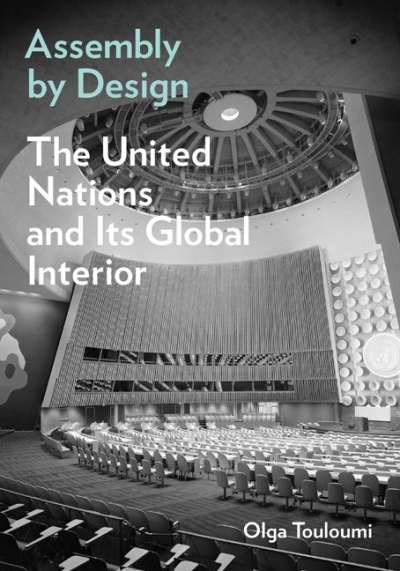
Assembly by Design. The United Nations and Its Global Interior

For almost seven years after World War II, a small group of architects took on an exciting task: to imagine the spaces of global governance for a new political organization called the United Nations (UN). To create the iconic headquarters of the UN in New York City, these architects experimented with room layouts, media technologies, and design in tribunal courtrooms, assembly halls, and council chambers. The result was the creation of a new type of public space, the global interior.

Assembly by Design shows how this space leveraged media to help the UN communicate with the world. With its media infrastructure, symbols, acoustic design, and architecture, the global interior defined political assembly both inside and outside the UN headquarters, serving as the architectural medium to organize multilateral encounters of international publics around the globe. Demonstrating how aesthetics have long held sway over political work, Olga Touloumi posits that the building framed diplomacy on the ground amid a changing political landscape that brought the United States to the forefront of international politics, destabilizing old and establishing new geopolitical alliances.

Uncovering previously closed institutional and family archives, Assembly by Design offers new information about the political and aesthetic decisions that turned the UN headquarters into a communications organism. It looks back at a moment of hope, when politicians, architects, and diplomats—believing that assembly was a matter of design—worked together to deliver platforms for global democracy and governance.


Olga Touloumi
Assembly by Design. The United Nations and Its Global Interior
University of Minnesota Press, 2024, 9781517913335
34,50 €