




























Direkt zum Inhalt

Warenkorb

  • Linda van Deursen, Alexandra Margetic (…

    Slideshow 1: Linda van Deursen: “Image Continuum”

  • Enrico Camporesi, Catherine de Smet,…

    Read Frame Type Film Or, Written on the Screen

  • Werner Lorenz, Roland May (Hgs.)

    Bauen am Limit. Traditionen und Transformationen eines…

  • Christina Haas, Anne-Catherine Schröter…

    Kernkraftwerke. Nuclear Power Plants.

  • Jorge Muñoz, Jesús Vassallo

    The Houses of Guadalajara. Ghosts of Modernity / Ghosts of…

  • David Bröderbauer

    Acker, Baulücke, Deponie. Ein Brachenatlas

  • Mark Terkessidis

    Gewalt am Denken. Wann beginnt Faschismus?

  • IDEA Magazine

    Idea 413. Fault Lines in Printing History: Risograph and…

  • AFF Architekten, Kim Grundlach (Hg)

    AFF Architekten. New Schools on the Block. A Typological…

  • Christopher Dell

    Michel Foucault oder die Heterotopie

  • Cassie Thornton & Magdalena Jadwiga…

    It's Too Late. Do It Anyway!

  • World of Interiors. December 2025 Mini Edition

  • Monique Wittig

    The Lesbian Body

  • Eva von Redecker

    Dieser Drang nach Härte. Über den neuen Faschismus

  • Amanda-Li Kollberg, Siri Lee Lindskrog

    Notes on Book Design: by Formal Setting

  • gerade nicht auf Lager
    Anh-Linh Ngo

    ARCH+ 263. Stadtnatur / Urban Nature

  • Wolfgang Ullrich

    Memokratie. Soziale Medien und autoritäre Bildpolitik

  • Ilka Becker

    Mykoästhetik. Pilze, Kunst und Kino

  • Inke Arns, Sabine Weier, Jan Wenzel,…

    Robotron. Code und Utopie

  • Sekou Cooke

    Black Architect

  • Katya García-Antón, Margarida Mendes (…

    The Word for World is Water. World-Building and Creative…

  • gerade nicht auf Lager
    Ferda Kolatan

    Misfits & Hybrids. Architectural Artifacts for the 21st…

  • Olaf Nicolai, Mariana Pende

    Dance Deluxe. Olaf Nicolai, Mariana Pende

  • Tiphaine Abenia, Louis Destombes,…

    Clara No. 11: The Ethics of Detailing

  • Marjan Unger (Autorin), Theo Smeets (Hg)

    Jewellery in Context. A multidisciplinary framework for the…

  • Volker M. Heins

    Sichere Häfen. Städte als Zuflucht

  • Krystina Castella

    Designing for Kids. Creating for Playing, Learning and…

  • Hans Teerds

    Space Is Politics. A Manifesto on Architecture

  • Felix Torkar

    Brutalist Berlin. An Architect's Guide to Brutalist…

  • Santiago Bogani, Igo Kommers Wender,…

    SHIFT. Architecture in Times of Radical Change

  • Michelle Christensen, Florian Conradi,…

    Re/Embodied Data. Ambiguities of Knowing

  • Tobias Allers

    Freiräume. Berliner Clubkultur. Berlin’s Club Culture…

  • Samantha Parsley

    Minor Keys. Gender, Inequality and Work In Electronic Music

  • gerade nicht auf Lager
    Olga Goriunova

    Ideal Subjects. The Abstract People of AI

  • gerade nicht auf Lager
    Susan Leigh Foster

    Knowing as Moving. Perception, Memory, and Place.

  • Joshua Comaroff

    Spectropolis. The Enchantment of Capital in Singapore

  • Olga Touloumi

    Assembly by Design. The United Nations and Its Global…

  • Lisa Lagova, Manon Fraser (eds.)

    Pure Fiction

  • Eva geulen, Carlos Sooerhase (Hg)

    Zeitschrift für Ideengeschichte Heft XX/1 Frühjahr 2026.…

  • Alexander Eisenschmidt

    At Home with the Collective. A Report from the Future of…

  • Heike Grebin (Ed.)

    Play the System. Parametric Approaches in Graphic Design

  • Uta Brandes, Tom Bieling, Michelle…

    Nutzen statt Besitzen. Michael Erlhoff Revisited

  • Sarah Horn

    Trans*Werden. Queere Zeitlichkeiten und Transitionen in…

  • Andrew Santa Lucia, Daniel Jonas Roche

    Antifascist Architecture. A Genealogy of Antifascist…

  • Freek Persyn, Seppe De Blust, Ilka Ruby

    51N4E. Negotiating Infrastructure

  • gerade nicht auf Lager
    Jamie Taylor

    Studio Electrophonique. The Sheffield Space Age, from the…

  • Bruno Munari

    Bruno Munari. Design and Visual Communication

  • Irénée Scalbert

    Totems: Selected Essays on Architecture

  • Katja Klaus (Hg.)

    Experiment: Learning Communities. (Schools of Departure No…

  • Regina Bittner, Katja Klaus, Philipp…

    Pedagogies of Machine Learning. (Schools of Departure No 4)

  • Hanna Mattes

    Hanna Mattes. Naked Janitor

  • Anna-Verena Nosthoff

    Kybernetik und Kritik. Eine Theorie digitaler…

  • Quinn Slobodian, Ben Tarnoff

    Muskismus. Aufstieg und Herrschaft eines Technoking

  • Marc Siegel (Hrsg.), Jack Smith

    What's Underground About Marshmallows? Texts by and…

  • Taavi Hallimäe, Neeme Lopp (Eds.)

    Leida Reader No. 1. Fifteen Selected Articles

  • Luis Manovel Mariño, Alberto Nicolau…

    Penshirubiru. Collective housing in Japan taken to its…

  • Baukunst

    In a way, it is also more primitive. Baukunst on technology…

  • Pier Vittorio Aureli

    Weniger ist genug. Architektur und Askese

  • Philipp Goll (Ed.), Oleksiy Radynski,…

    Leak. The Other Side of the Pipeline

  • Leander Nowack (Ed.)

    Territorial Control. Case Studies on European Borders

  • Edward W. Said

    Representations of the Intellectual

  • Geert Lovink

    Die Brutalität der Plattform. Von der radikalen Kritik zum…

  • Sung Hong Kim

    Seoul Urban Architecture. Rising from the Crushing Bowl

  • Paul Virilio

    Paul Virilio. Bunker Archaeology

  • Fatima-Zahra Lakrissa

    Turning Frozen Yesterdays into Fluid Now... Or how to…

  • Spike

    Spike Art Magazine Issue 86 Salad Days

  • Benze De Ream

    The Blue Flower Syndrome. Multithread 01. Benze de Ream

  • gerade nicht auf Lager
    Nora O'Murchú, Janez Fakin Janša

    Are You a Software Update? Reader with Wassim Z. Alsindi,…

  • Kenneth Hujer

    »All das passierte in diesem irrsinnigen Milieu Frankfurt…

  • Marius Babias (Hg.)

    Portrait Mode. Moyra Davey

  • Valentina Tanni

    Exit Reality. Vaporwave, Backrooms, Weirdcore, and Other…

  • Alexander Schröder, Dominic Eichler,…

    MD72. Door Slamming Festival (2007 - 2018)

  • Marek Poliks & Roberto Alonso…

    Exocapitalism. Economies with absolutely no limits

  • Diedrich Diederichsen, hg. von Carolin…

    Ästhetik im Planetarischen Zeitalter

  • Christoph Liepach (Hg)

    Gera ostmodern

  • gerade nicht auf Lager
    Eline Benjaminsen, Dayna Casey

    Collapsed Mythologies. A Geofinancial Atlas

  • Christoph Liepach, Irina Schultheiß (Hg)

    In Lusan geht die Sonne auf

  • Elena Malzew, Lisa Klosterkötter (Ed.)

    Über Brücken - Bridging

  • Birgitta Heid

    Faszination Sichtbeton. Werke des Architekten Bernhard Heid

  • dérive

    dérive N° 102, Spekulation (Jan - Mar 2026)

  • Michael Klipphahn-Karge

    Bildökologie (Digitale Bildkulturen)

  • Kayoung Kim, Lisa Marie Zander, Marius…

    Versammlung der Mikropolitiken

  • Jiyoung Yoon, Kirenia Martinez Acosta

    Invisible Tapestry Vol. 2.

  • TAT.

    TAT.1 - Wand / Wall

  • Ita Dreyfus

    Niche Design. A Magazine exploring where design flourishes…

  • Christoph Liepach (Hg)

    Max braucht Gesellschaft. Der Kulturpalast des VEB Maxhütte…

  • gerade nicht auf Lager
    Melissa Bruntlett, Chris Bruntlett

    Women Changing Cities. Global stories of urban…

  • gerade nicht auf Lager
    Caspar Henderson

    A Book of Noises. Notes on the Auraculous

  • Louis Möckel

    Sonic Footprints. Ecology of Technophony

  • Sarah Robinson

    Architecture of Resonance. From Objects to Interactions

  • Anna Pollmann, Christopher Möllmann (Hg)

    Schlüsselbegriffe gesellschaftlichen Zusammenhalts. Ein…

  • gerade nicht auf Lager
    Nick Newman

    Protest Architecture. Structures of civil resistance

  • Bailey Bestul

    Reuse of Architectural Components

  • gerade nicht auf Lager
    Florian Urban, Barnabas Calder

    Form Follows Fuel. 14 Buildings from Antiquity to the Oil…

  • Market Cafe

    Market Cafe Magazine Issue 9 Invisible Data

  • “Bizhan Jazani”, Parham Ghalamdar

    SIAHKAL 2.0: An A.I. resurrected discourse on Marxism…

  • Mario Mainetti (Hg)

    Diagrams. A Project by AMO/OMA

  • Chris Kraus

    The Four Spent the Day Together

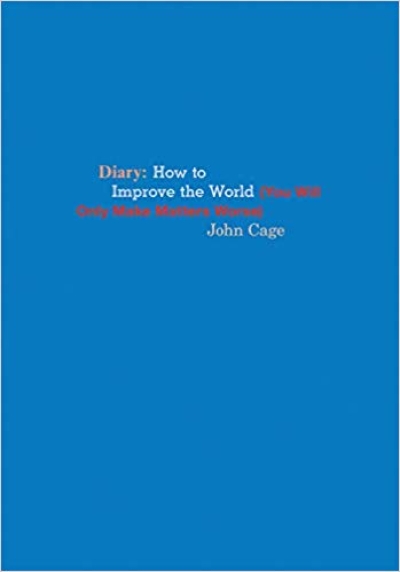
Diary: How to Improve the World (You Will Only Make Matters Worse)

"Over 16 years, beginning in 1965, John Cage compiled anecdotes, observations and koanlike tales, originally typing everything on an IBM Selectric and using chance methods to determine the formatting of texts that twist down each page. The Siglio edition preserves the graphic effects, but, more important, it gives a sense of the company he kept during these years--Marcel Duchamp, R. Buckminster Fuller, D.T. Suzuki--and of his passionate feeling about a world locked in a state of perpetual warfare. Cage has a reputation for being a Zen-inspired wit. He was also much more, an intensely engaged moral thinker." -Holland Cotter, New York Times
Now available in an expanded paperback edition, Diary registers Cage's assessment of the times in which he lived as well as his often uncanny portents about the world we live in now. With a great sense of play as well as purpose, Cage traverses vast territory, from the domestic minutiae of everyday life to ideas about how to feed the world. He used chance operations to determine not only the word count and the application of various typefaces but also the number of letters per line, the patterns of indentation, and--in the case of Part Three, originally published by Something Else Press--color. The unusual visual variances on the page become almost musical as language takes on a physical and aural presence.
While Cage used chance operations to expand the possibilities of creating and shaping his work beyond the limitations of individual taste, Diary nonetheless accumulates into a complex reflection of Cage's sensibilities as a thinker and citizen of the world, illuminating his social and political awareness, as well as his idealism and sense of humor: it becomes an oblique but indelible portrait of one the most influential figures of the 20th-century American avant-garde.
Collecting all eight parts into a single volume, coeditors Joe Biel and Richard Kraft also used chance operations to render the entire text in various combinations of red and blue (used by Dick Higgins and Alison Knowles for Part Three) as well as to apply a single set of 18 fonts to the entire work. In the editors' note, Kraft and Biel elucidate the procedure of chance operations and demonstrate its application, giving readers a rare opportunity to see how the text is transformed.
This expanded paperback edition reproduces the 2015 hardback edition, with a new essay by mycologist and Cage aficionado David Rose and, most important, an addendum that includes many facsimile pages of Cage's handwritten notebook of a ninth part in progress, bringing the reader into compelling proximity to Cage's process and the raw material from which Diary was made.


John Cage
Diary: How to Improve the World (You Will Only Make Matters Worse)
Siglio, 2019, 978-1-938221-21-7
gerade nicht auf Lager