Direkt zum Inhalt

Warenkorb

  • Alain Badiou

    Wofür steht der Name Sarkozy?

  • gerade nicht auf Lager
    Donna Haraway

    Die Neuerfindung der Natur. Primaten, Cyborgs und Frauen.

  • gerade nicht auf Lager
    Stefanie Schulte Strathaus, Florian…

    Wer sagt denn, dass Beton nicht brennt, hast Du’s probiert?

  • gerade nicht auf Lager
    Henri Lefebvre

    Writings on Cities

  • Loretta Napoleoni

    Rogue Economics. Capitalism's New Reality

  • AD

    AD 174. Vol. 75. Nr. 2. Samantha Hardingham. The 1970'…

  • An Architektur

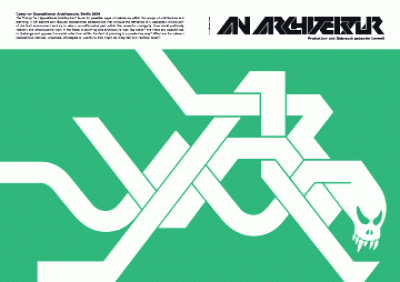
    An Architektur 18: Camp for Oppositional Architecture:…

  • Johan Frederik Hartle

    Der geöffnete Raum. Zur Politik der ästhetischen Form

  • An Architektur

    An Architektur 16-17

  • Vera Beyer, Jutta Voorhoeve, Anselm…

    Das Bild ist der König. Repräsentation nach Louis Marin

  • An Architektur

    An Architektur 15 / FFM 11: Europäische…

  • An Architektur

    An Architektur 14: Camp for Oppositional Architecture

  • An Architektur

    An Architektur 11-13: Theorie und Praxis der Kartografie

  • An Architektur

    An Architektur 10: Gemeinschaftsräume

  • An Architektur

    An Architektur 04-09: Krieg und die Produktion von Raum

  • IDEA Magazine

    IDEA 296. Books <preposition> graphic design

  • IDEA Magazine

    IDEA 293. Stanley Donwood / Vacances. DD-DDD / Dimensions…

  • gerade nicht auf Lager
    An Architektur

    An Architektur 01-03

  • Pro qm

    Gutschein / Voucher

  • Siegfried Kracauer

    Das Ornament der Masse. Essays

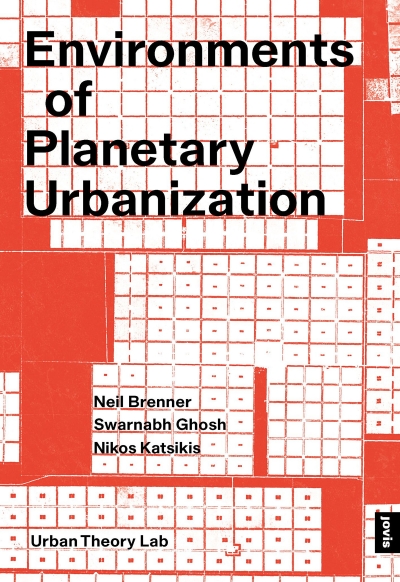
Environments of Planetary Urbanization

Environments of Planetary Urbanization

What role do spaces beyond the city play in urbanization? How have such spaces been transformed during the geohistory of capitalism? This volume brings together texts collaboratively produced by three researchers in the Urban Theory Lab to address these questions. Planetary urbanization is understood here not only with reference to the global expansion and proliferation of cities, but as an evolving web of metabolic relations between cities and the diverse operational landscapes that support them across the earth. Through studies of operational landscapes in various regions of the world and critical analyses of inherited approaches to urban theory, the authors portray capitalist urbanization as a metabolic monstrosity that degrades the biospheric foundations of both human and nonhuman life. 


Neil Brenner, Swarnabh Ghosh, Nikos Katsikis
Environments of Planetary Urbanization
Jovis, 2025, 978-3-98612-209-6
38,00 €