


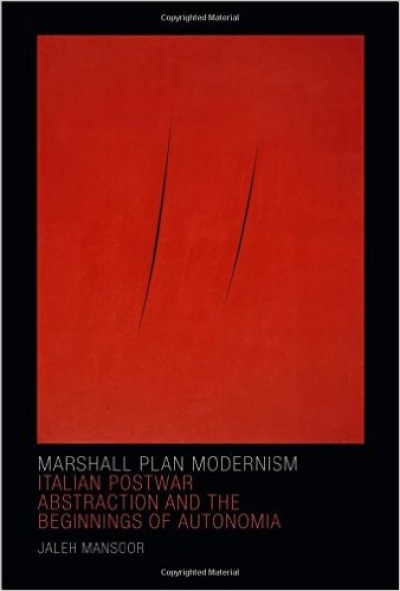
Marshall Plan Modernism: Italian Postwar Abstraction and the Beginnings of Autonomia
Focusing on artwork by Lucio Fontana, Alberto Burri, and Piero Manzoni, Jaleh Mansoor demonstrates and reveals how abstract painting, especially the monochrome, broke with fascist-associated futurism and functioned as an index of social transition in postwar Italy. Mansoor refuses to read the singularly striking formal and procedural violence of Fontana's slit canvasses, Burri's burnt and exploded plastics, and Manzoni's "achromes" as metaphors of traumatic memories of World War II. Rather, she locates the motivation for this violence in the history of the medium of painting and in the economic history of postwar Italy. Reconfiguring the relationship between politics and aesthetics, Mansoor illuminates how the monochrome's reemergence reflected Fontana, Burri, and Manzoni's aesthetic and political critique of the Marshall Plan's economic warfare and growing American hegemony. It also anticipated the struggles in Italy's factories, classrooms, and streets that gave rise to Autonomia in the 1960s. Marshall Plan Modernism refigures our understanding of modernist painting as a project about labor and the geopolitics of postwar reconstruction during the Italian Miracle.