














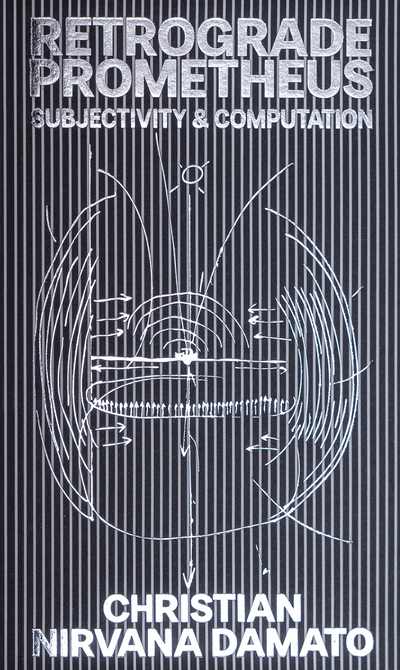
Retrograde Prometheus. Subjectivity & Computation
This book proposes a reversal of a common convention within contemporary critical theory: the idea that desire is an entropic, creative and potentially emancipatory force. Against this view, the author figures desire as negentropic, structured around stability, prediction, and calculation. Far from being disrupted by technocapital, this desire finds there a troubling affinity, and is seemingly propelled toward increasingly self-destructive forms. Retrograde Prometheus, part a poetic narrative, and part speculative treatise, seeks to reformulate these categories through which we understand desire, along with all the existential, ethical, and political implications that such a radical change in perspective may entail.
This book is composed of 46 subheadings (§), each addressing subjectivity, desire, and progress in relation to concepts drawn from natural history and the sciences, including topics such as psychocomputation, negentropy/entropy, sexuality, capitalism, and political agency. These parts are concatenated and recursive, ranging from miniatures to longer essays, as well as aphoristic reflections and microfictions. These modules are conceived as a concatenation of concepts that together build a unified theory that responds not only to thinkers such as Jacques Lacan, Sigmund Freud, Gilles Deleuze, Bernard Stiegler, or Slavoj Žižek, but also to the broader amalgamation of what we call psycho-analytic theory, the philosophy of technology, and contemporary theories concerning the human subject, technology, and progress.
So much has changed since Anti-Oedipus (or even since Anti-Narcissus!), let alone since the Seminars of Lacan—the amount that has changed since Freud, therefore, is unimaginable. Where is psychoanalysis today, post-internet, post-COVID? What has changed for the subject (as well as how we understand the subject) due to these advancements in technology and science, with these changes in how we understand our history and genesis, and with how we understand the relationship between technology, language and worlds?